Wednesday, October 26, 2011

Bataan Death March

 “In war, you win or lose, live or die - and the difference is just an eyelash.” Douglas MacArthur


Douglas MacArthur was not like by most Filipino soldiers during the Bataan Peninsula Battle. They called him "Dugout Doug" for abandoning the Philippines when it was captured by the Japanese. Although, the president ordered him to immediately leave the Philippines and go to the U.S. This made him appear like a quitter to the Filipinos, but MacArthur was actually an exceptional general and field Marshall in World War 2. After the war, he returned to America as a hero, and received a Medal of Honor for his service in the Philippines campaign.

The Bataan death march was an effect of the Bataan Peninsula battle. The Bataan Peninsula battle included the Japanese fighting the Americans and Filipinos, led by Douglas MacArthur. American and Filipino soldiers had plenty of ammo, many other important resources such as food was scarce. More soldiers were actually dying from hunger and malnourishment, than from enemy fire. A ship could not come and rescue them, because most American ships had just recently been sunk at Pearl Harbor. They were told to hold out for as long as possible against the Japanese. This led them to believe that they were soon going to be rescued, but help did not come. They were able to hold out for a long time, but surrendered to the Japanese on April 9, 1943.
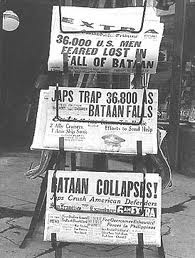

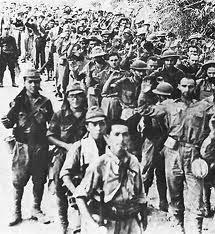
Japanese Lieutenant General Masahuro Homma took the surrendered soldiers prisoner. There were so many soldiers that the only way  the Japanese could transport them to their camp was to make them march 70 miles. The marched continuously all day and all night. If they stopped to go to the bathroom or rest, they were immediately shot. There was food and water all around them, but the prisoners were not given any.The overwhelming heat also caused the soldiers to receive "the sun treatment". They died of thirst, got heat exhaustion, and heat exhaustion. Japanese soldiers would force the prisoners to sit in an open field to be further exposed to the son. It made the march even more miserable.

An Amercing survivor of the Bataan Death March opens up about his experiences in this interview:

Interview with Survivor

Invasion of Italy

In late July of 1943, as they began to win the battle at Sicily, the Allies decided to go for a full invasion of Italy. Italy, knowing that they would lose, made secret negotiations with the Allies. This made the Germans suspicious, and they sent in their own troops to take control of the Italians and of the front. The British and U.S. soldiers under Mark W. Clark landed on the beaches on September 9th. Germans launched an attack, winning for four days. Then the Allies began to fight back, trying to keep the Germans concentrated in Italy to stop them from spreading their influence back to France or Russia. Once the Allies made it into Naples, they worked to obtain other fortified positions in Italy. Germans, led by Albert Kesselring, wanted to hold up the Allies enough that many would die before winning each of their victories. Next, the Allies moved north. It took them six months to cross a line of highly defended mountains around Cassino, called the Winter Line. They started this in October of 1943. United States troops under John P. Lucas failed to capture this area at first, waiting too long to attack. This gave Germans time to get back up and keep the Allies out. Finally, in May 1944, using bombs to get through mountain areas, the Allies found a gap in the line to get through. In June 1944, they entered Rome –just  2 days before D-Day. It is hard to image how people living in Italy could have felt during this time. The following is a personal account of Peter Ghiringhelli, an Italian civilian during World War 2: http://www.bbc.co.uk/ww2peopleswar/stories/03/a1993403.shtml

Breakout From Normandy

Seven weeks after the D-Day landing, the First United States Army launched an offensive attack against the Axis powers, codenamed Operation Cobra. Guided by General George S. Patton, the Allied troops succeeded in encircling the German troops into surrender, but not without fierce fighting and incredible casualties.

The Lost Evidence: Breakout From Normandy (1/5)

The Lost Evidence: Breakout From Normandy (2/5)

The Lost Evidence: Breakout From Normandy (3/5)

The Lost Evidence: Breakout From Normandy (4/5)

The Lost Evidence: Breakout From Normandy (5/5)

Invasion of Sicily

From July 9th to August 17th, 1943, British troops under Montgomery worked with American troops under Patton invaded Sicily. This was an important battle, as the Allies knew, because if they won, they would gain a good European foothold, but if they lost, it would be a major loss that could lead to disaster. So the Allies launched Operation Husky. This was a two-pronged attack, with Montgomery and the British landing in the Southeast and moving north, while Patton and the Americans landing in the Southwest and guarding the flanks of the British. Montgomery and Patton were fierce rivals, and Patton resented getting the lower position in this operation, as he felt Montgomery moved too slow and would claim all of the glory. On July 9th, the groups first landed in Sicily, and fired on Italy. With the British and paratroopers in place, they were able to surprise the Italians and wade ashore. Hours later, Germans attacked the American held beaches, and American troops and navy tried to counter these attacks.  Due to a lack of communication, however, they accidentally shot down many of their own planes. In the battles in Sicily and North Africa, the use of tanks was very important. At the battle of Sicily, Tiger Tanks were used against the Allies, who wanted naval guns to stop them. White Phosphorous was very important in stopping the Italian offensive and turning the war around. As the British approached Messina, the Germans blocked them, causing Patton to decide to try to push towards the western tip of Palermo. He attacked at Messina when he got there, as the British were still stalled, and outflanked the German positions on the Northern Road. When the US and British troops arrived together at Messina on August 17th, the Axis troops were just leaving Sicily, giving the Allies this all-important foothold that allowed them to work to invade Italy.

The link below gives a personal story of Ron Goldstein, a man who fought in Sicily:
http://www.bbc.co.uk/ww2peopleswar/stories/74/a2370674.shtml

Philippines

After being invaded by Japan in December 1941, the United States strove hard to protect its bases stationed there. The American-Filipino army kept the Japanese at bay until April 1942 where they were defeated in the Battle of the Philippines. The allies eventually drove the Japanese off in an amphibious attack during the Philippine Campaign. Hostilities on the island continued until the end of the war in August 1945.


John F Holland, 78, on the death of his father in the Philippines as a child:
“I vividly remember that Sunday afternoon, sitting on the floor in our living room, when Mother entered the house and told us of the attack on Pearl Harbor. Amid all the chaos and radio broadcasts, I remember worrying about my birth certificate, since I was born in Schofield Barracks, Hawaii.
On October 14, 1944, Ruthie, Jimmy and I watched silently as Daddy boarded a plane bound for somewhere in the Southwest Pacific Area. It was a mixture of sadness and pride, and our mother stood tall and brave as the plane disappeared into the sky…Mommy was always an example of Duty- Honor-Country.
The most powerful memory, for all of us, came in early February 1945, when a telegram was delivered to our home informing my Mother that my Father had been killed, in the Philippines, on January 29, 1945. It was his 44th birthday.
About a week after this, Mommy brought the three of us together to talk about the future. She said that we had to charge ahead and stressed the need to think positively. From that day forward, I have always made a major effort to follow her authoritative request (I have not always succeeded).
As I remember, we were spending the summer on the Chesapeake Bay and I heard that an “Automatic” Bomb had been dropped by Japan. Although the Germans had surrendered several months earlier, this rush of events was difficult for a 12 year old boy to fully comprehend. This was followed by a second bomb on the 9th and finally the surrender on the 15th.
The only thing I really remembered, at that point, was that my Father would not be coming home.”

Tuesday, October 25, 2011

Singapore

During the time of World War 2, Singapore was part of the British Empire. Therefore, there was a British base in Singapore. After the attack on Pearl Harbor, Japan was expanding throughout the Pacific region. It made sense that they attack Singapore, an obvious target in the Pacific. Singapore included the Strait of Malacca, which is one of the most important shipping lanes in the world. Also, capturing Singapore would also deny the allies its port facilities and using it as a base to attack the Japanese in the Western Pacific.

"I do hope we are not getting too strong in Malaya because, if so, the Japanese may never attempt a landing." - British Army Officer

The British were told that the Japanese were poor fighters, and large machine guns were set up around the beaches to defend Singapore. This made the British overly confident going into battle.
The Japanese were actually very determined fighters. It was an important part of their culture to be loyal to the country during war. Coming back home after defeat in battle would bring shame upon your family for generations. Before going to Singapore, Japanese soldiers were given a pamphlet saying, "When you encounter the enemy after landing, think of yourself as an avenger coming face to face at last with your father's murderer. He is a man whose death will enlighten your heart."
The guns pointed out to sea could have been very useful if the Japanese had come by sea, like the British expected. On February 15, 1942, the Japanese, led by Tomoyuki Yamashita, came in planes and attacked fields in Singapore and sunk many ships. The Japanese were outnumbered 1 to 2, but still came out with a victory.


The fall of Singapore is considered Britain's worst defeat by the Japanese. It caused great humiliation for Britain. Prior to Singapore, the Japanese were thought of as useless soldiers only capable of defeating the inferior Chinese military. It showed the rest of the world just how powerful and scary the Japanese had become. Japan's victory also showed Japan how to fight the rest of World War 2; with speed and savagery. Be willing to die at any cost, and spare no enemies. The Japanese could not be stopped until August of 1945, with the use of the atomic bomb at Hiroshima. 

Pearl Harbor


The build up to Japan's attack on Pearl Harbor started when President FDR froze Japanese credit in the U.S. after Japan invaded French-Ind China (Vietnam). This would not allow trade for oil or scrap metal until Japan got out of China.

Japan has 3 possible ways to respond:
1. Give the U.S. what they want (After all, they have already lost 100,000 men in China)
2. Find oil somewhere else. (Ex. Dutch East Indies, Indonesia)
3.  Look to Isoroku Yamamoto


Isoroku Yamamoto was a Japanese man who was educated in the U.S. This allowed him to know U.S. structure and military tactics. He had a realistic opinion, and knew that Japan could not defeat the U.S. in a long war. They needed to hold out, and neutralize the U.S. To achieve this goal, Yamamoto created 'Operation  Z'. The plan was to buy the Japanese time by continuing diplomatic relations with the U.S. Then, the U.S. moved their Pacific fleet from San Diego to Pearl Harbor to intimidate Japan, by having the fleet closer to them. The next part of Operation Z became to attack Pearl Harbor, and follow it with attacks on other U.S. and European countries. This could damage the U.S. pacific fleet enough to but Japan 2 years as a free hand in the Pacific. Japan would simply make it too costly for the U.S. to try and defeat them.

Pearl Harbor is considered the worst naval disaster in U.S. history. In result, 18 American ships were sunk or seriously damaged and 188 American planes were destroyed. One of the ships destroyed by Japanese naval forces was the Arizona Battleship. 1,177 crewmen were killed that day, and half of those men were in the Arizona. Today, we can visit the Arizona Battleship memorial built over the remains of the ship.

The reason for Japan's success was the well thought out planning that went behind it.The Japanese had spies confirm that nothing could go wrong, and they knew their route very well so there would be no hesitation on their part.

U.S. made mistakes leading up to Pearl Harbor. U.S. intelligence cracked Japanese code and knew about the attack prior to it happening, but their lack of communication did not allow their message to be sent in time for warning.
 
Pearl Harbor can also be viewed as a disaster for the Japanese. It angered and saddened the U.S. very much, providing them with motivation and determination. U.S. carriers did not happen to be at Pearl Harbor that day, and World War 2 was a carrier war. Without their carriers, U.S. could have not secured as many wins as they did. Also, the Japanese could not launch their 3rd wave attack, because the U.S. had become very alert by then.